Unfortunately, there is not enough time in the day to record every rehearsal and listen to it later. Nor can someone allow a guest to work their ensembles—the groups they will ultimately lead on stage—on a daily basis. This leads to the question: what is the biggest difference between listening to one's ensemble on and off the podium? The answer is simple: the physical act of conducting.
Let me begin by saying that keeping time with the baton has its place in ensembles of all shapes and sizes. Many pieces, especially those with metric shifts and numerous transitions require a conductor to guide the group. Other pieces are so complex that time is the conductor's primary responsibility. In pieces other than this, though, what is the conductor's most important job? Arguably, it is listening, and teachers should do everything in their power to heighten and exploit this skill to its fullest. There are two obstacles, however, that stand in the way of this goal.
Many teachers can identify with the fact that the score can draw the conductor in, shutting down one's eyes and ears. This, combined with the physical act of time keeping, makes listening even more difficult. Much like a smart phone our brains have a certain number of apps available (tuners, metronomes, soundboards, recorders, sticky notes, you name it), but only so much memory with which to run them. Isolating and running only the essential apps frees the brain to run these programs more effectively and efficiently. The same holds true with conducting. Taking away time beating removes a physically repetitive process that doesn't necessarily contribute much, particularly at the onset of a rehearsal cycle. STOP beating time. Allow the ensemble to COLLABORATE and actively LISTEN to the group.
STOP
The first few rehearsals on a new piece of music can be frustrating for a teacher, especially when preparing for Large Group Performance Evaluation (LGPE). After days, weeks, or months of debating whether or not to program "X" piece, one steps on the podium and hears... not "X" piece. The group isn't shaping the melody, they don't yet understand how one phrase leads to the next or how their part fits in with the rest of the group, and articulations are the least of the teacher's worries. Picture your ensemble on the first day of rehearsal with a new piece. Imagine what your students look like singing or playing. Where are their eyes? Are they locked onto you in anticipation of discovering how you want to phrase the music? Or are they staring at their parts, glued to the notes and rhythms? Teachers sometime forget what new music looks like to students. Take the following clarinet part, for instance:
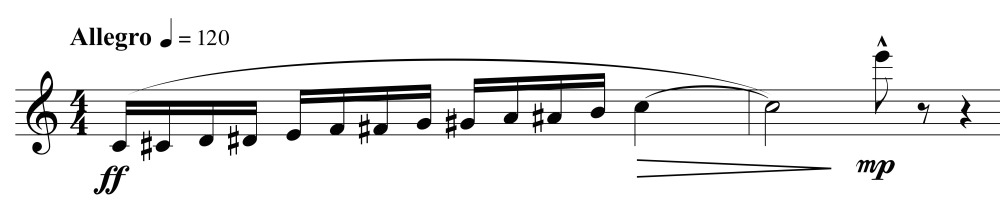
The teacher might notice some inherent difficulties but overall it's "just a chromatic scale followed by a high note." The students should be able to look up after a few minutes of studying the music and work with the conductor. More often than not, however, the students see the following:
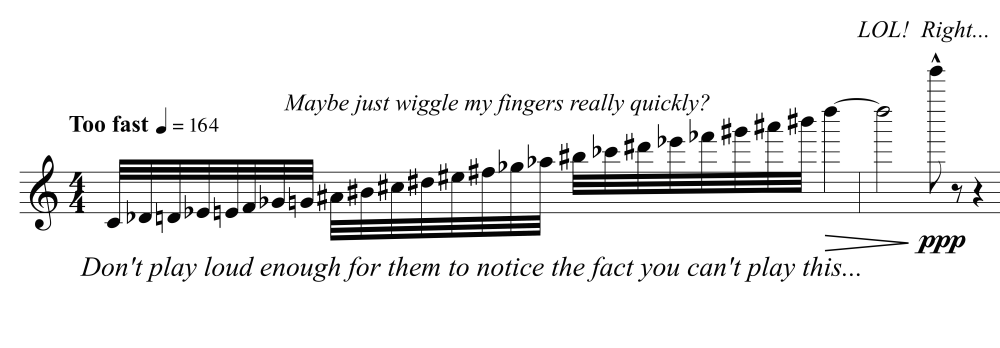
Often when a conductor sees difficult passages—weird time signatures, hemiolas, and numerous entrances—he or she sees no problem in locking their eyes on the score to ensure that everything is executed correctly. The same holds true for the students in one's ensemble; they will not want to look up until they are comfortable with their part, either! LGPE often pushes technical abilities in an effort to teach skills. It is much simpler to demand a performer's attention when the technical aspects of a piece are simple. Unfortunately, this is becoming more and more of a rarity in repertoire and performances with each passing year.
These types of pieces present the perfect opportunity to stop beating time. With students' faces buried in the page they have little to no room to glance up, check the tempo, and stay in time with the conductor. They are most likely listening to a time source in the room—percussion, quarter notes in the trombones, or an ostinato in some other section. The students are best served with an aural, not visual, source of pulse at this point in the process. These initial rehearsals—when teachers feel like all they do is keep time while students learn their parts—can also be detrimental for one's growth as a conductor. If a teacher spends the first 40 to 60 percent of the rehearsal cycle beating time he or she is essentially learning bad habits that will have to be broken later on in the process. Of course, the ensemble often needs something to help them keep time. Fortunately, there is a simple solution: use a metronome.
If a teacher was asked to think back to his or her college studio days, chances are they used a metronome while learning exercises, etudes, sonatas, or orchestral excerpts. There is also a good chance that their metronome displayed the beat visually along with its beeping or clicking. With two options to internalize the pulse, which aspect is more effective, the visual or the aural? It is easier to listen to the beat and get into a groove than watch something move from side to side or blink to show the pulse. It is much more difficult for students to sing or play a tricky syncopated passage with their metronome on "silent," primarily because the performer must shift between the metronome and music. The same holds true with one's ensemble members. By constantly having to watch the conductor for time the group's attention is turned away from listening. Visual time is incredibly difficult to absorb for students when their primary focus revolves around the notes and rhythms.
However, it is understandable that this is not an option for some teachers. Many are completely opposed to using a metronome in rehearsals. There are other alternatives to consider, though, which use a metronome in a different ways to achieve the goal of your ensemble playing or singing in time. The first is keeping the metronome on your stand and using the "tempo tap" function. This allows you to diagnose the group while they're playing in order to see how well tempo is being maintained and address any issues that might arise. If you are not comfortable giving up visual timekeeping, another trick involves playing the metronome loud enough that only the teacher can hear it. This method is often a great way to diagnose areas where the ensemble pushes or pulls from the pulse. Another approach that is particularly effective comes from Robert Ambrose and Stuart Gerber. Instead of having the metronome dictate every beat, use it to dictate every other, every third, etc. This reveals how rhythms might want to rush or drag over multiple beats and helps create a much greater sense of line. It can also be used to set up a stronger rhythmic feel for the music, providing a backbeat in 4/4 time or a lilt in 3/4, all the while helping the group keep steady time. I highly suggest you download the document (just search for "Ambrose and Gerber metronome" in Google; it should be the first item listed) and explore their ideas and concepts. As a final suggestion, try and find a metronome sound that is as unobtrusive as possible. The standard marching band metronome setup, for instance, can be extremely loud and overbearing, sometimes covering up the entire group. Try to find a metronome that is audible but still allows the members of the ensemble to hear themselves.
Unfortunately for conductors, the baton and hands—barring snapping, clapping, hitting the stand with the baton, or talking while students play—can only provide a visual source of time. If patterns are too large or insistent the students receive a constant barrage of information every time they choose to look up. Instead of giving the same priority to every beat one's pattern can be minimized, allowing the conductor to serve more as a guide, a sort of GPS. In one's car the GPS is always there but remains mostly silent, much like a conductor with a minimal pattern. The performers are welcome to glance up but they know that when the GPS speaks something important is coming. Emphatically providing every beat to the group is similar to a GPS announcing 1.5, 1.4, 1.3, 1.2, 1.1... miles until a left turn. It won't be long before the students' eyes "mute" the information the conductor is trying to provide.
Minimizing one's pattern also sets the ensemble up for better communication during rehearsals and performances. Because verbal interaction is often not an option the conductor must grab the group's attention through motion alone. Harnessing students' peripheral vision—an extremely responsive reflex available even with a student focusing primarily on their part—is a powerful tool for teachers. Keeping time, unfortunately, can get in the way. The pattern in the right hand becomes a sort of visual "white noise," creating a constant flow of visual information that prevents sudden movements and other important gestures from receiving attention. If a conductor's pattern size uses 50 to 75 percent of one's range of motion he or she often needs to make the left hand's gesture even larger to establish that something else is more important than the pattern. When timekeeping is taken away from the conductor the movement from each gesture stands a much greater chance of getting noticed by the ensemble. It allows motion to become a more significant factor in gaining the ensemble's attention, allowing the use of both hands for musical expression and shape, marking a score or taking notes while the group is rehearsing, walking around the room to address individual issues and successes, or simply focusing all of one's energy on listening. If the conductor does start to emphasize the pulse that means the ensemble needs to address it! If one always dictates time it makes it extremely difficult for the students to discern when tempo is an issue.
As discussed, there are pieces that require the conductor to keep time, but how can one make the pattern as minimal as possible yet still keep the ensemble together? If the conductor considers each beat in a pattern to be equally important this creates a major issue. I would argue instead that what a pattern truly needs to keep the group together is a way to focus on location, not pulse. Performers often use barlines as checkpoints during these types of pieces and this is something that the conductor can exploit. Instead of using a pattern that emphasizes every beat equally, try using a pattern that more easily displays the barlines themselves:
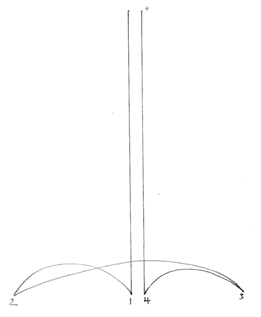
4/4 "Barline" Pattern
By minimizing the second and third beats, beat one becomes a sort of mile marker for the group, letting the musicians know that they're on the right road and performing within the speed limit. This "barline" pattern—taken directly from my mentor John Lynch—is much easier to control and does more than just reduce the right hand's effort. It provides a relaxed source of time for the ensemble, instilling the group with a sense of calm during difficult passages. If tension is the enemy than this certainly helps to fight it.
COLLABORATE
At some point, obviously, the metronomes must disappear. Now that keeping time is no longer the teacher's primary responsibility it has to transfer to the group, particularly those sections that have a "time source." Many pieces have lines that can serve as a built-in metronome. Whether it is the percussion, a clarinet ostinato, the basses singing quarter notes, or a pizzicato line from the cellos there is almost always something available for the performers' ears to grasp onto.
Many teachers would agree that one's ultimate goal is to create independent musicians, to empower the students to play without relying on the conductor for every entrance, tempo, or dynamic. How can one accomplish this? To start, use the score to show the students what is going on around them. Point out time sources. Add in parts layer by layer. Make them aware of the fabric and texture of each phrase. Guide the ensemble through a collaborative process, ask questions as to what they hear, and allow the musicians to rely on each other's sounds to establish time. If the group is having trouble keeping the pulse, first fix the time sources. Empower the students with the knowledge that their part, no matter how easy or difficult, has an impact on the overall time of the group.
Fact #1: empowering the students to keep time can be freeing but it also has the potential for disaster. Fact #2: this actually takes place in many rehearsals whether the teacher wants it to or not (this might be comfortable for some and terrifying for others). It doesn't matter if the conductor has on neon gloves or a flare gun; if a student plays cowbell or hi-hat they are in control of time, not the baton. The rest of the group will want to follow what they hear, not what they see.
Collaboration brings an additional benefit: it heightens listening skills beyond simply time and pulse. Now that students are listening for time they can be expected to listen for other aspects of music. Showing the ensemble how the music fits together raises the students' musical awareness and can quickly fix many balance and style problems. Forcing students to open up their ears at the beginning of the rehearsal cycle provides many benefits down the road.
LISTEN
A musician's most effective tool is their ability to listen, and it should be the teacher's primary responsibility on and off the podium to maximize its use. If one's listening skills are diminished in any way it is a disservice to the ensemble; this is a teacher's primary method of determining what the problem might be and how to fix it. When one stops beating time in the right hand and asks the ensemble to keep it on their own it allows the teacher to identify problem areas much more quickly. It allows them to focus all of their energy on their ears. It also raises the power and control one has as the liaison between the ensemble and the audience.
The best teachers are those who can identify a problem, address the problem, and fix the problem. It is rare that one can solve ensemble issues by working even harder within a conducting pattern. A teacher's listening ability is the best tool available; one should try and maximize this skill by any means necessary. I have the privilege of working with student teachers and seeing their excitement when they open up a new score. Many immediately jump to the time signatures and start conducting. This is revealing, because too often these patterns become the focus of their rehearsals. Much like the students their eyes are buried in the score and they focus on conducting to the point where their ears are almost completely closed off. If both the players and conductor are doing this, though, who is listening?
These concepts might sound crazy to some, but I assure you that they work. Some (if not all) will need to be adapted for your ensemble depending on level, instrumentation, and age, but these are not just theories. Having the students take responsibility for the time is something that the Wind Ensemble and I work on in every rehearsal to the point where the group plays without a conductor. If the ensemble can stay together without someone on the podium keeping time the musical responsibilities of the conductor increase tenfold. I have also used the techniques discussed to achieve this with a variety of ensembles. Two particular examples come to mind, the first a collegiate group on Holst's First Suite and the second a middle school band on William Owens' Egyptique. Both groups did not look up for time but for musical information. This was only possible because each group had a grasp of how their individual parts fit together and knew what to listen for—not watch—in order to stay in time. Perhaps the most humbling instance of these concepts coming into play, however, took place with an honor band on Van der Roost's Puszta. Even after utilizing a barline pattern the horns had a difficult time fitting their offbeats into the melody. We tried it again but this time I stopped conducting altogether. Lo and behold, they used their ears and played it perfectly. Instead of worrying about the visual and the aural time the performers could focus solely on the latter and fit their offbeats into what they were hearing.
Challenge your ensemble, no matter their age or ability level, to execute time on their own. In turn this will challenge your listening skills, preparation, and teaching. Letting go of the time is a frightening notion that takes a while for both the students and the teacher to get used to. In the end, though, I truly believe the ensemble will rise to the occasion.