
The purpose of this study was to test a hypothesized model of parental involvement-home
environment in music, parenting style, and psychosocial maturity that influence
academic success and musical success. Participants (N=1223) were enrolled in music
programs (grades 4-12) in six regions of the United States. Measures of Parental
Involvement-Home Environment in Music (PIHEM), Parenting Style (PS), psychosocial
maturity (PSM), academic success (AS) and musical success (MS) were verified
through confirmatory factor analysis to represent latent variables. The model using these
variables obtained an adequate measure of fit (standardized RMR=.078), indicating a
good model fit. A large total effect for AS was found with MS and moderate total effects
with PS, PSM, and PIHEM. A large total effect for MS were found with PIHEM, with
moderate effects with both PS and PSM. The PIHEM with AS and PD with MS effects
were both entirely indirect. PS's largest total effects were with PIHEM and PSM, and a
small but meaningful non-significant effect was found for PIHEM with PSM.
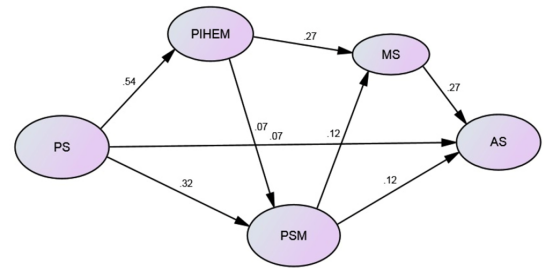
There were definately aspects of this study that seemed particularly noteworthy:
The first is that Dr. Zdzinsky used a method of analysis that is rather rare in our profession, but beginning to be catch on in populatrity. Structural Equation Modeling allows an investigator to examine variables and their interrelationships in such a way that we can predict how changes in one variable might effect several others. In this case, we have a good idea how parental involvement impacts music success, and how that related to academic success. The relationship in this kind of analysis is not simply correlational, it is directional. Also, the magnitude of the relationships is indicated in percentages of standard deviations - so a one standard deviation change in parental involvement in this model predicts a 27% of a standard deviation increase in the musical success of any given subject. Though not astronomical, certainly not inconsequential.
The one reservation I had with this project was one involving the observed variables that were used to define musical success. Dr. Zdzinsky was presented with a very difficult variable to define, and chose as well as can be expected, however, his two observed measures were music grades and performance on the Music Achievement Test. Though certainly a measure with a track record, perhaps not one which was designed for this use.
The second study I wanted to share was by Clifford Madsen. His project was titled The relationship between teacher preparation and long-term teaching effectiveness. His abstract read:
Effective teaching or more particularly identifying specific ingredients of effective teaching
for teacher preparation is of utmost concern for every teacher preparation program. The
study of effective teaching is no small undertaking for many reasons, the least of which
concerns how and in what ways students as well as others determine what is effective.
The most apparent aspect of evaluation concerns the assessment of subject matter
mastery. Students often express another aspect as "that teacher cares for me" or "that
teacher makes me do my best" or "I like to be in her/his class." One might ask what
constitutes the precise ingredients attributable to "achieving", "liking" or "caring."
Sometimes there is an important subject matter variable, as in the case of music where
students take great joy from listening or participating in the subject matter itself.
Sometimes there is a strong teacher variable that transcends or enhances this subject
matter. Sometimes there does not seem to be any specific aspect to which one might
assign the ingredient(s) that cause or at least promote "liking" or "caring" or doing ones
best. Some conjecture that it is students themselves who are most capable of
assessing their degree of effectiveness by their rating of meaningful and effective tasks
and teaching techniques. The present investigation concerns many learning activities
and learning experiences that have been studied across the years. Seventy-five music
education students enrolled in a capstone course prior to graduating completed ten
learning activities previous research deemed important for effective teaching. These
activities ranged from demonstrating the ability to specify precise learning objectives to
actual teaching short music activities. One year after graduation each of these ten
assessments was compared to assessments made by two experts concerning current
teaching effectiveness. All 75 students had previously ranked these same ten activities
at the end of the course and their rankings were compared to results from the experts.
Results indicated that while most of the learning activities evidenced positive moderate
correlations with final teacher effectiveness as judged by the experts, there was a large
disparity between students' rankings and the experts' teacher effectiveness ratings.
There were many interesting aspects to this investigation as well, but the part that
struck me the most was what aspects of the course in question related most strongly to
their long term teaching effectiveness and what did not. The activities that related
strongly to teaching effectiveness were: ability to make transfers of information from one
setting to another, and ability to construct a thorough and complete task analysis. But
most suprisingly, the task that had the least relationship of ten activities was a short
student-selected teaching demonstration. As that is the activity that most teacher
training programs use to assess long-term teaching potential, this lack of substantive
relationship (r = .10) is almost shocking. The researcher had no real answer for why this
might be the case, but is currently thinking about how he is going to look into this
further.
While all studies have many interesting points, these two seemed to have clear applicability to things that many of us deal with every day. Neither researcher claimed to have final definitive answers, but both studies provoke some interesting questions. Of course, if you would like a more complete and accurate picture of these studies, they will be in the proceedings from the Research Seminar of the ISME website soon. I do hope you will check them out so that you can judge for yourself what questions should be asked next.