"Composing and arranging music within specified guidelines." National Standard for Music Education number four is the standard many of us pretend is not on the list so we can focus on the singing and performing standards numbers one and two. But with some planning and preparation we can have some fun with our students, and maybe even write a musical along the way.
Each year I attempt to focus on standard number four in at least one grade level of my elementary music classes. Last summer as I was trying to choose a spring musical for my fifth grade it hit me—why not have them write the program?
Why Write an Original Musical?
I believe many music teachers avoid the composition standard for a variety of reasons. Colleagues have shared hesitations such as not feeling confident in their own writing skills, concerns with keeping a class focused and minimizing behavior issues, and generally not knowing where to begin or how to incorporate the standard into a general music lesson. These are all valid concerns and I hope to at least address how to begin. My experience with this standard has shown me that giving students the opportunity to offer creative input into a performance gives them a sense of ownership and a deeper connection to the performance rather than simply performing a song on stage with a class. My main objective for having students create their own program was to provide a performance opportunity that they could feel they had a part in creating as well as a sense of commitment.
How We Started
After deciding to have my fifth grade compose their own spring musical, I created a timeline for the process. Having directed many elementary musicals, I knew I needed the songs ready for rehearsal at least three months prior to performance. In order to have the songs ready for rehearsal I wanted the story to be close to completion. I put together the following timeline:
| Activity | Date |
| Project Introduction | November 21st - 22nd |
| Story Idea Sharing | November 28th - December 2nd |
| Song Lyrics and Script Dialogue | December 5th - December 16th |
| Music Creation in GarageBand | January 4th - January 13th |
| Auditioning, Song Learning, Choreography, Scene Rehearsing, Final Staging, Etc. | January 16th - April 24th |
| Performance | April 25th |
A brief introduction relating the process to the students was important for them to develop a sense of comfort in tackling a big project and to create a sense of excitement in the project as well. Most of the students had been performing musicals with me for four years and knew what a performance involved. The first (and just about only) rule I felt was necessary was "no comments would be allowed" following suggestions from students. This rule was important to keep the ideas coming without students feeling their ideas would not be valued. Many students love to give criticisms such as "that's a dumb idea," or "no, that won't work." I made sure to write every idea presented on the board. The students did a fine job of gravitating towards those ideas that would work best. I also made sure we followed the "keep it simple" concept. There were ideas given that required more resources than our elementary school could provide, such as recreating their favorite movies. I told students I wanted to keep the set simple, with minimal changes.
The Process
I knew one of the logistical difficulties I would face was in the school's "Specials" schedule. We had four classes of fifth grade students, and I saw two classes one day and the other two the next. Seeing classes every other day made it more difficult to maintain progress, but not impossible. I spent the first couple minutes of each session bringing the class up to speed on where we were with the story and character development, and then we would continue with idea and story development.
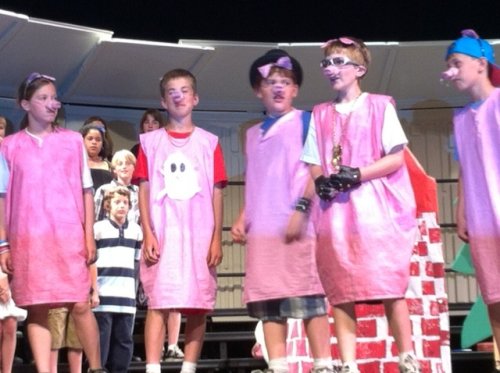
After only two days, several classes came up with a similar idea - an adaptation of the Three Little Pigs story. Once we started having similar concepts, I decided we needed to pursue them. Each class was receptive to this idea when I presented it to them. We then needed to come up with WHAT was going to happen in our story. This part of the process went fairly quickly. For the next week or so, I wrote down the ideas each class gave, presented them to the next class to be voted on, gathered new ideas, and the process would continue. After a week or so, the story began to solidify itself and I stopped presenting an event or idea for each class to vote upon. Instead, I had each class decide whatever needed to happen next in the story. That made the process go even quicker as I did not have to wait until the next day to allow the other two classes to make a decision on a story idea.
The Songs
After a couple weeks the story was in rough form but fairly complete, minus a few details and of course, dialogue. I then chose four different points in the story that I believed would be appropriate for a song, and assigned one to each class. I kept them focused on what was happening at that point in the story, and started getting ideas for lyrics. A day or two was spent on giving me sentences about something, not necessarily complete sentences, just statements somewhat related to that point of the story. We then started taking each statement and putting them together into something that somewhat flowed and was related to what was happening in the story. We then used GarageBand® and began listening to rhythm loops. (If your school does not use Macintosh® computers, Ableton Live® is a loop-based program similar to GarageBand that runs on PC computers.) When a particular loop resonated with most of the class, usually with something like "yeah, that one!" from most of the class, I would drag the loop and begin creating a song. Once there were several instruments tracks, we would then look at the lyrics and see how they fit into some sort of rhythmic pattern, such as a rhyme or rap. The last step was to structure the sentences into logical verse/chorus sections.
 Once the songs were basically ready, we could begin learning them while still finishing
the script. I chose to wait until about this point to begin adding names to the
characters. The temptation would have been too strong to get caught up in thinking
up names before we even knew what the show was about.
Once the songs were basically ready, we could begin learning them while still finishing
the script. I chose to wait until about this point to begin adding names to the
characters. The temptation would have been too strong to get caught up in thinking
up names before we even knew what the show was about.
After the songs and script were fairly complete, we were ready for the normal musical staging activities involved with putting a musical together, which for the sake of the article I will not describe, as I assume most are familiar.
Giving It A Name
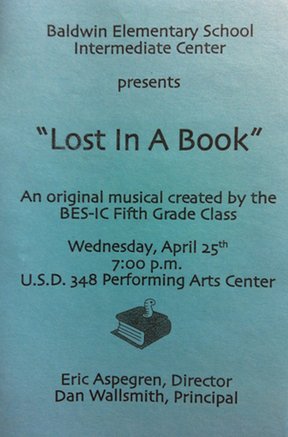
Once the script, characters, and songs were in place, it was time to come up with a name for the musical. Several times along the way, a student would ask "What shall we call the play?" I usually replied something to the effect of "Let's wait and see what the script tells us." When the script and songs were mostly complete, I let each class suggest whatever came to mind for a title. We ended up with over thirty suggestions, some rather unusual but most very unique, and I let each student choose three. I was afraid it might be close, but "Lost In a Book" had by far the most votes and it became official.
How It Went
When the performance was finished, I wanted to find out what students really thought when I introduced the activity to them months prior. I told them to be honest if initially they felt it was a task beyond what they were capable of, and most students admitted it was a big task to attempt. However, during the weeks leading up to the performance I could see the students' enthusiasm growing, and there were many students that proactively volunteered for whatever task was necessary. I believe my objective was met of providing a performance that my students had a part in creating, thereby giving them a greater sense of commitment to the project. I had a number of parents that informed me after the performance they could see the enthusiasm the students had for their creation. I could see the overall level of participation increase as students had more and more input into the creation of the show and believe it was successful. We watched a recording of the performance and I could see in the video the smiles on their faces on stage as well as the smiles as they watched the recording.
During the creation process and even up to choosing a name for the musical, even though many students gave ideas, I never saw anyone be upset their idea was not selected. Instead, everyone seemed happy with the results because they had input into the process, even if things were not as they suggested.
Supporting the Common Core
As music teachers, we should use any opportunity we can to support the Kansas Common Core Standards in our school. Writing your own story, script, and musical can provide support for the English Language Arts Common Core Standards. A few standards covered by this project: RL 5.5 - "Explain how a series of chapters, scenes, or stanzas fits together to provide the overall structure of a particular story, drama, or poem;" RL 5.6 - "Describe how a narrator's or speaker's point of view influences how events are described;" and RL 5.7 - "Analyze multiple accounts of the same event or topic, noting important similarities and differences in the point of view they represent."
Don't Be Afraid To Start
If you have experience in putting together an elementary musical, you are familiar with the organization, planning, and preparation involved. By starting a little earlier and getting the students excited about the creative process, you can provide a creative experience for your students that gives them some exposure to the composition process. Do not be afraid to let the students be creative. As I told my students many times during the creation of their program "Lost In a Book," my job was to steer the boat so that we arrived at our destination, but they were doing the rowing.
Baldwin Elementary School Intermediate Center
presents
"Lost in a Book"
presents
"Lost in a Book"