

Kansas Music Educators Association was chosen as the winner of the "Music In Our Schools Month Award" for the most outstanding contributions to Music Advocacy. The award stemmed from Frederick Burrack and Phillip Payne's work with the "Impact of Budget Cuts on Kansas' Schools" survey and the KMEA Executive Council's Fall 2011 presentation of these survey results to the Kansas State Board of Education. An American flag flew over the United States Capitol Building in the month of March 2012 as part of the celebration of Music In Our Schools Month. The presentation of that flag in a beautiful framed case from the National Association for Music Education to KMEA was on Sunday morning, June 24, 2012 at the National Assembly in Baltimore, Maryland. Leaders from all of the MEA's across our nation were present during this award ceremony.
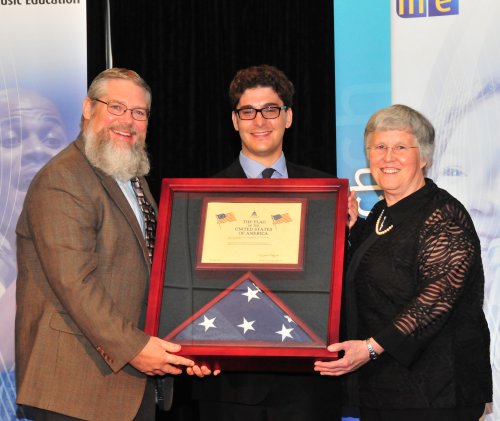
Left to right:
Craig Manteuffel, President, KMEA;
Christopher Woodside, Director, NAfME Center for Advocacy and Public Affairs;
Nancy Ditmer, President, NAfME
WE NEED TO HEAR FROM YOU
Due to the increased elimination of music teaching positions over the past four years, it is important to repeat the survey at least one more year to see if this negative trend has slowed. We also need to begin to identify if the quality of music learning and teacher satisfaction has been impacted. Below is the link to a survey sponsored by KMEA to learn the impact that current budget challenges has had on music education. It is important for KMEA to receive a response from every school district in the state of Kansas. Please identify one music educator as a representative from your school district to collect the necessary information and complete the survey on behalf of your district. The survey link below will be open on September 1, 2012 through December 31, 2012. We hope all your district's music educators will assist in providing this important information. Survey link at: https://surveys.ksu.edu/TS?offeringId=196793
NO CHILD LEFT BEHIND AND TEACHER EVALUATION
Many things are occurring nationally that are good for music education in schools. The U.S. Department of Education has announced that six more states, including Kansas, have been granted NCLB waivers. The waiver allows Kansas to establish "annual measurable objectives" (AMO) in reading/language arts and math in determining adequate yearly progress (AYP). The waiver also places Kansas schools into one of three categories; Reward Schools, Priority Schools, and Focus Schools. The Focus Schools are those with the greatest achievement gap. This decision also allows music educators to be evaluated on their own teaching within music. A Kansas teacher evaluation model has recently been piloted in at least five school districts. The evaluation tool is called Kansas Educator Evaluation Protocol (KEEP) and can be viewed or downloaded at www.ksde.org/Default.aspx?tabid=4400 (176 pages). Overall, the teacher evaluation tool looks similar to most evaluation sheets. It is divided into four basic categories; 1) Learner and Learning, 2) Content Knowledge, 3) Instructional Practice, and 4) Professional Responsibility. The evaluation tool is "general" enough to be used for any classroom setting or subject area.
CORE ARTS STANDARDS
The National Coalition for Core Arts Standards (NCCAS) writing teams representing dance, media arts, music, theatre, and visual arts met in Reston, Virginia, June 19-22. The five teams are drafting the Next Generation Arts Standards. The meeting focused on embedding student learning throughout instruction in schools and began developing cornerstone assessments for the new Core Arts Standards. NCCAS is committed to developing a next generation of voluntary, researched-based arts education standards that will build on the foundation created by the 1994 document, support the 21st-century needs of students and teachers, help ensure that all students are college and career ready, and affirm the place of arts education in a balanced core curriculum. Writers from around the country were chosen in 2011 in an open call to the arts fields of dance, music, theatre, and visual arts. In January, a media arts team was added in recognition of the growing interest in the diverse 21st-century media tools that have created new modes of expression and teaching in public education. Be watching for more on the enhanced music standards. (nccas.wikispaces.com/) These will guide what will be expected for the Common Core.
NEW ORGANZATION SUPPORTING ARTS EDUCATION
Kansas has a new Alliance for Arts in Education (KSAAE) with a mission of ensuring that the arts remain an "integral part of a quality preK-12 education." (www.ksallianceforarts.org) Now more than ever, the challenges facing arts educators in Kansas require an active coalition of parents, students, educators, and friends of the arts to strongly speak out about including the arts as part of a well- rounded education. This is a critical time for arts education, at the local, state, and national level. The recent round of state budget cuts has placed increasing pressure on local school boards and administrators to find additional reductions in their local budgets. Too often, these decision-makers mistakenly conclude that arts programs should be amongst the first programs considered for cutbacks or in some cases even eliminated. Be watching for the most recent news and participate in supporting Arts Education in Kansas.
KANSAS MUSIC ADVOCACY NETWORK
KMEA has been working to develop a state-wide network of high-profile advocates who can be contacted at a moment's notice to help support music in schools on the district and state levels. We have heard from two of the six districts. Help us to create this state-wide network of support. Submit one or two names of high-profile music education supporters who are influential in the educational/cultural/business community and knowledgeable of the educational validity of music education. (Please contact the advocate for permission to submit his or her contact information.)
| Advocate Name: |
| Title: |
| Address: |
| City/Zip: |
| Phone Number: |
| E-Mail Address: |