Table 1
Distribution of school districts responding to the survey
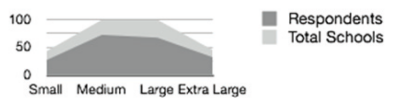
62% of medium (251-550)
59% of large (551-2000)
72% of X-large (< 2000)
Positions Lost
For the 2010-2011 academic school year, a total of 224 music teaching positions were reported as cut: not renewed or replaced. (see Table 2 below)
Table 2
Music positions lost in Kansas per year
| Teaching Area | 2011 | 2010 | 2007-2009 | 4-year total |
| Elementary | 53 | 32 | 17 | 102 |
| MS General | 30 | 15 | 11 | 56 |
| Band 5-8 | 28 | 13 | 8 | 49 |
| Band 9-12 | 25 | 20 | 6 | 51 |
| String 5-8 | 17 | 5 | 6 | 28 |
| String 9-12 | 10 | 12 | 4 | 26 |
| Choir 5-8 | 20 | 14 | 6 | 40 |
| Choir 9-12 | 10 | 13 | 3 | 26 |
| Other | 31 | 19 | 13 | 66 |
| Totals | 224 | 143 | 77 | 444 |
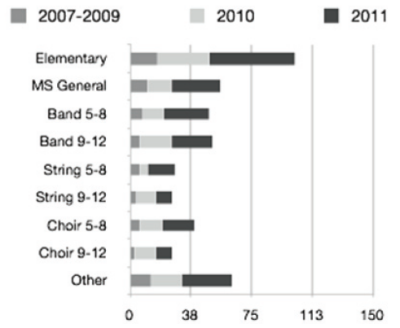
In comparison to the reported position losses from the prior years, 143 positions for AY 2009-2010 and 77 for AYs 2007-2009, it is clear that the budget cuts have had great impact to the number of music teaching positions not replaced across Kansas' schools. Of great concern is the number of elementary and middle general music teaching positions lost, 37%. Of equal concern is the loss of middle-level positions that build upon the foundational learning from elementary school and prepare students for the advanced study in high school, 45%. We must be cautious that the educational foundation of our music programs remains strong. A graphic chart demonstrating the number of music teaching positions lost: not replaced or renewed. (see Table 3)
Table 3
Number of music teaching positions lost in Kansas per teaching area
The 'Other' category most likely represents teachers of multiple areas and the respondents did not know how else to categorize these positions.
In the midst of these cuts, there were no reports of music content areas eliminated from the overall music program, although the researchers have been notified since of some programs eliminated. Although it is a good indication that few programs have been eliminated, there are 444 less teachers than 4 years ago to teach these same number of music classes. If generalized across the population, there may be nearly 500 less music teachers in Kansas.
It is important to note that this survey did not identify if the positions lost were filled with full-time or part-time faculty or if the position lost represents a certified teacher. Future surveys should identify more specifically the type of position cut.
Change in Funding
In 2011, 48% reported a loss of funding with 13% reporting a loss of more than 25% from the former year's level of support. In 2010, 60% reported a loss of funding with 22% reporting a loss of more than 25% from the former year's level of support. It is encouraging to identify a decrease in funding cuts, but we are not sure if the reported cuts are in addition to prior year cuts or if these are funding cuts to programs that had not experienced prior loss in budget. The other challenge in understanding the depth of funding cuts is knowing if prior funding was sufficient.
Other Areas of Impact
Unfortunately, Kansas' school music programs see another increase in additional fees placed upon students for participation, 18% of the programs reporting an addition of student fees in 2010 and an additional 20% in 2011. Although respondents were instructed to identify changes unique to this current academic year, it is difficult to confirm if the additional fees were added to additional programs or accumulative to former programs. (see Table 4)
Table 4
Other areas of impact to Kansas' music programs resulting from funding cuts
| 2010 | 2011 | |
| Addition of Student Fees | 18% | 20% |
| Reduction of travel expenditures | 52% | 41% |
| Reduction of Capital improvement | 37% | 30% |
| Unfunded Increase of Responsibility | 19% | 23% |
| Teaching Outside of Expertise | 19% | 22% |
An increasing number of music teachers are being asked to teach outside of their expertise, 19% in 2010 and 22% in 2011. The data as collect cannot identify whether these percentages reflect music teachers moving to a different area of music or teaching in a different discipline. Future surveys might request more detailed explanation of new expectations. Either way, music teachers are experiencing additional responsibilities and expectations placed on their former teaching loads.
Discussion
Because Kansas experienced major loss of music staff during 2010, it was hoped that cutbacks would slow during 2011. But findings show an astounding increase in staffing losses. The impact on music education programs in Kansas' schools is at a dangerous level. We cannot ignore the resulting loss of educational experiences being eliminated from the lives of our students or take it for granted.
With the trend of the current data showing an increase in loss of positions as well as increased workloads to counterbalance the loss of teachers, the impact these actions have on the teachers and students in our music programs has the potential to be devastating in many schools. We must recognize the perils facing our childrens' education by understanding the nature of the issues and the core value of music education in Kansas' schools.
We must educate our parents, community members, and policy makers regarding the importance and value of the arts through increased visibility and connections within and among the communities. The public must be made aware of the harsh realities that lie ahead if we continue traveling the road we are currently on. We must work to maintain the core values of American education, as founded by Lowell Mason in the infancy of the American School System, by embracing the power and value of music for everyone.
With the trends in cuts to music education being exposed, professional development remains an increasing need since music teachers are taking on more responsibility, teaching in less familiar areas of music or other subjects, grappling with increased teaching duties, and, meanwhile, having reduced district support for traveling to state conferences or other PD opportunities. Teachers are having a more difficult time traveling to, and fitting professional development opportunities into their busy schedules. With less time, less funding, and increased teaching obligations music teacher education programs and state MEAs must become more proactive in preparing music teachers for these realities.
We had a great day sharing this data with legislators at Arts Day at the Capitol on March 8. Every time a legislator asked a question or made a statement, we were able to offer a definitive response. Governor Brownback joined our meeting and listened to the concerns facing music education. We also had productive meetings with the Department of Education, The Chief of Staff to the Governor, Senator Garrett Love, Representative Annie Kuether, and Ms. Carolyn Wims-Campbell, Kansas Board of Education Vice Chair. Avian Bear and Mike Quilling met with Senator Majority Leader Steven Morris for nearly 30-40 minutes. KMEA leadership is working for you, effectively advocating for music education across the state.