Moving forward, we arrive at my sixth year of teaching and my second year of teaching only K-4 music. My principal, Kevin McKay, approached me before school began and said that the state of Kansas had increased the minutes recommended for students' P.E. time.1 He suggested that the P.E. teacher and I combine classes (two at the same time) on Fridays in the gym so that students would be able to meet these recommendations. He also said he believed that it is a good thing for students to witness two teachers working together. Mr. McKay said, "Music and physical education lend themselves to strengthen each of their curricula through movement, rhythm, and dance activities. Our students benefit by learning how to interrelate with one another while simultaneously exercising and enjoying music in a positive environment."
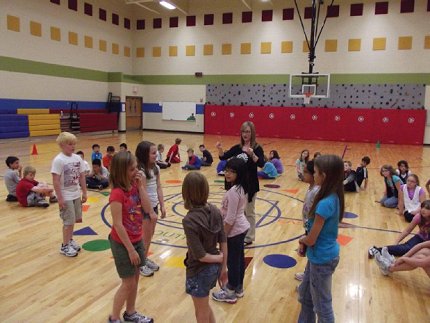
Students at Apollo Elementary get ready for Music and Movement Friday.
Although our principal was fully supportive of combining music and P.E. for the betterment of all students, I was concerned about how to teach with another person who teaches a different content area than my own. As luck would have it, our P.E. teacher, Mr. Ford, not only did sports throughout high school, but was also in choir and currently gigs on his guitar and sings—a P.E. teacher who also is a musician. He even voluntarily runs the sound mixer for my concerts. Yes friends, I hit the jackpot!
I started thinking of all the things I could do as a music teacher with the luxurious space of the gym and having two classes at once. Any type of folk dance, line dance, pop dance, circle music games, and even Wii Music (which was a collaboration between MENC and Nintendo in 20093) and dance games could work in that environment. We also have our concert stage facing the gymnasium; therefore, any type of brief music rehearsal I needed to do would be easier with two classes of the same grade instead of one. It would also help to give students an idea of what a concert would be like.
We first talked about how to structure our M&M (Music and Movement) Friday classes. At first, we were getting used to each other's teaching and classroom management styles. After trying and not always being successful with the M&M class structure, we eventually decided that music time would usually be before P.E. time. This structure has also lent itself to our discipline plan: if students choose not to follow directions during music or P.E. time (such as talking or inappropriate behavior), they may need verbal reinforcement or to simply watch others for a short period of time during class.
When music first begins, either a concert rehearsal or learning a new dance, I do not give any instruction until it is silent. I also give students a brief description of the dance they will learn, such as its history, the form (how many parts it has), and the tempo. Giving a brief description helps students to discriminate, classify, and categorize types of music, cultural perspective, and music vocabulary when we are learning new songs and dances in music.
We do not usually have behavior issues, but the problems we encounter during music time are usually created by students who prefer P.E. activities to music activities, and vice versa. Therefore, a good way I have found to motivate students to listen and do their best is to remind them that the amount of time music takes is up to them, and the rest of the time is for P.E. Please know that full support is given from the P.E. teacher during the music portion and both music and P.E. are considered equally important.
Another benefit of teaching music on M&M Fridays in the gym is that it eliminates any social stigmas and allows everyone to participate. Students now have "permission" to enjoy folk dancing or any other dances under the label of "movement" as opposed to "dancing." That being said, I do not disguise the cultural and historical importance of folk or other dances in my lessons.
Mr. Ford is flexible when it comes to the type of music rehearsal I need with the students. If the students are going to be doing a music activity for over ten minutes, we first have the students play an instant activity or jog three to eight minutes (depended upon their grade level, which is determined by P.E. expertise. It also helps wear them out a little before they need to concentrate on music instruction). If I need less than 10 minutes with the students, we ask the students to sit on a shape around the center circle of the gym or if there are no shapes left, to sit behind someone who is already on a shape. This forms a double circle, which also lends itself to many dances I teach on M&M Fridays.
Combining classes on Fridays has influenced me to incorporate a dance for each concert. This is easy to rehearse on Fridays instead of when I have one class at a time in the music room, where we work mainly on singing and playing instruments. I also get to see all 450 students in one day and so if I need to review something with them, especially for concerts, I can work with or remind them in one day as opposed to waiting two days.
While Mr. Ford and I work hard to collaborate on our two independent areas which lend to one another's nicely, I will point out that I am a professional musician who does not have my teaching degrees in P.E. as Mr. Ford does. I am athletic and assist Mr. Ford with P.E. in any professional way that I can, but I rely on him to teach the P.E. portion of our M&M Fridays. Likewise, while I realize that Mr. Ford is also a musician, he does not have the music degrees I have in how to teach music and it is my job to teach all music concepts, including all dances, on M&M Fridays. We have personalities that work well with one another and respect one another's professional teaching areas and expertise.
The benefits of combining classes with our P.E. teacher, in my case, are: 1) planned rehearsals in the gym without making reservations or special plans, 2) seeing all students on one day before the weekend for concert instructions or reminders, 3) incorporating a dance in every concert with all students, and 4) students see adults working together as a team. It took a little while for Mr. Ford and me to figure out what works best for us, but now that it is in place, we both look forward to it and so do our students.
Endnotes
1 www.kansasfitness.org/recommendations.htm 3.19.2012
2 Bernstorf, E. (2008). When kids experience music: They win! Kodály Envoy, Vol. 35, No. 1, p.18.
3 www.menc.org/news/view/menc-teachers-test-nintendo-wii-music-in-the-classroom 3.20.2012