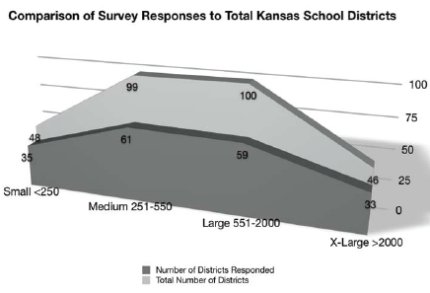
There are 293 school districts in Kansas and 190 school districts responded to the survey: a response rate of 64.4%. In the figure below, you see a surveyed sample representative of all school sizes.
GOOD NEWS
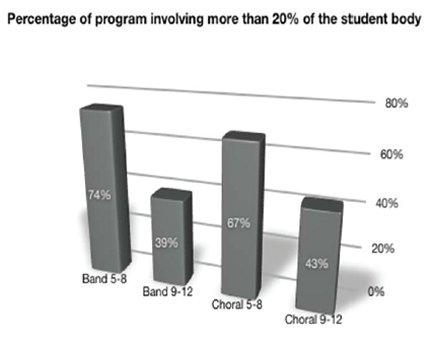
Participation in Kansas' band and choral programs are strong. More than 20% of the student body is reported in the following:
74% of the middle school bands
39% of the high school bands
67% of the middle school choirs
43% of the high school choirs
16% of the schools with string programs
POSITIONS CUT IN THE PAST THREE YEARS
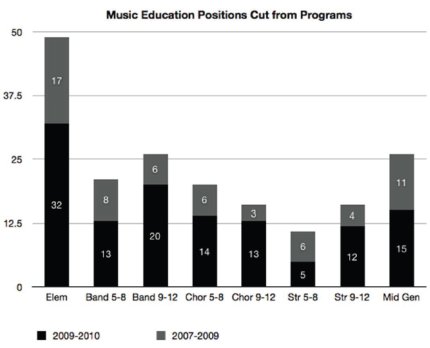
The survey indicated that in the past three years, 185 music education positions had been cut: 124 in the past year and 61 in the two years prior.
The dark column in chart below indicates the number of positions cut this past year in each category of music education. The gray above indicates the number of positions that had been cut in the previous two years. Generalized across the entire population, up to 167 music education positions may have been cut in 2009-2010 and 250 from 2007-2010.
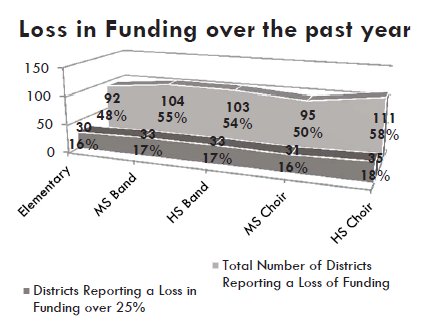
Over the past year, up to 55% of reporting districts reported a loss of funding for the current fiscal year with respect to their vocal and instrumental music programs. Furthermore, up to 33% of those districts music programs (18% of all respondents) registered funding cuts over 25% of their previous year's operating budget. The percentages shown in the chart on the next page are those compared to the total respondents. If we generalize this to the entire state, up to 168 districts might have cut their music programs' funding and up to 53 districts could have cut their music programs' budgets by over 25%.
Other areas investigated by the KMEA advocacy committee included the ones showed here.
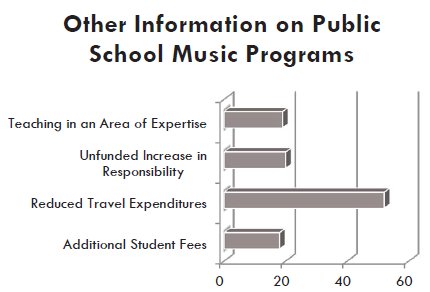
- 19% of the responding districts reported that music teachers were being asked to teach courses outside of their area of expertise.
- 20% of the respondents reported an increase in responsibility with no compensation.
- 50% of the responding districts reported a reduction in travel expenditures.
- 18% of the reporting districts are turning to student fees to supplement the unfunded expenditures.