

Convention Issue 2015-16
|
Select Issue
Loading
|


 Print this page
Citation View Print this page
Citation View
How Natural Vocalization Can Reveal Expression in Instrumental Music
As an ensemble director, studio teacher, and adjudicator, the one area of performance
that most often leaves me wanting is musical expression. For performers of all ages,
this seems to be a challenge to perfect. A chipped note here or there doesn't
necessarily shatter the effectiveness of a performance, but one that is musically or
expressively dull is doomed. Yet how often have we all sat through concerts or recitals
where the most compelling thing in the room was in the attempt to discern if the font
used on the program was Times or Times New Roman?
Why does this seem to be such a common struggle? Certainly there can be many contributing factors including technical ability, expectations of directors and private teachers, and the emotional maturity of the performer(s). However, several years ago I was struck with the thought that expressive playing shouldn't be foreign to even the youngest performer. After all, with rare exception, we are all naturally expressive—especially vocally. Consider the ensuing explosion when the plaything-of-the-moment is snatched away from a 2-year old. How about the reaction of a young woman when her long-time boyfriend finally stops dragging his feet and pops the question? No doubt we all expressed an annihilation-of-the-known-world teenage feeling or two upon discovering our social plans had received a malevolent parental thwarting. So, if indeed we all have the capability to be expressive and convincingly expressive at that, why are our musical performances so often not? Is it because we do not know what is musically appropriate? Perhaps, but I would go so far as to say that even the youngest of performers among us can form judgments about good uses of musical expression and that which is poor or non-existent. (American Idol auditions, anyone?) The more I thought about it, the more I wanted to see about tapping into the natural expression that we most often express verbally. To me the obvious application for instrumentalists was vocalization. Singers obviously have the most natural instrument. Everyone sings, even if it only in very private settings. Though we try to get to the point where our playing is second nature, instrumental performance asks us to do unnatural things. No one comes out of the womb buzzing the perfect horn embouchure, but we certainly do raise a vocal ruckus shortly after we are introduced to the world. As instrumental teachers and conductors we are often encouraged to use singing as a teaching tool. Sometimes we have students sing while tuning, but it often does not go much beyond that. As a student I was rarely asked to sing in my lessons or in rehearsals. When I did sing, it was usually out of obligation, rather than a desire for musical discovery. Yet, why not use what we do naturally to help what we do unnaturally? The Goal The goal of vocalization is to allow a student to discover expression in music through natural singing choices. This can be done by giving value to the vocal syllables that emerge when vocalizing or singing and then exploring what these different syllables might indicate expressively. The Basics There are three basic guidelines for instrumentalists using vocalization in this manner.
Natural (uncoached) syllable choices can help students discover their own expressive ideas. As you and/or your students sing, pay particular attention to the choice of beginning consonants, changes in vowel usage, and dynamic variation. All of these may indicate subtle (or not so subtle) musical expression such as articulation, direction of line, tension and release, climax, resolution, color, etc. For example: Beginning Consonants - Using "t" to begin a syllable will obviously indicate a firmer articulation, perhaps even some sort of accent. A "d" to begin a syllable indicates softer articulation. An "l" ("loo" or "lah") could imply legato. A "y" ("yah") can show weight, arrival, or other emphasis. Vowels - "Eah" and "aah" sounds (as in "dee" and "dah" from the Dvorák example above) can indicate stress/tension and relaxation/release respectively. A change from "oh" to "ooo" might reflect tone color changes. Syllable Length and Endings - Any good jazz instructor knows the difference between a punch that is played "daht" and one that is played "dit." Even deciding whether to end a note or phrase with a consonant or vowel sound has important musical indications. Different people are sure to use alternate vocal syllables to indicate similar expressive ideas. This is not a problem by any means and should be encouraged. However, it is critical to keep in mind the goal is to strive toward appropriate musical expression, not to see how many different syllables can be jammed into a vocalized passage. The Process The four- (or five-) step process I am suggesting to incorporate vocalization and singing into instrumental settings is intended only as a basic guide. It may be used as a step-by-step process, but more ideally is should be adapted to whatever it is appropriate for your students and your teaching style. Step 0 - The Starting Point Starting here assumes limited or no previous use of singing. The primary goal is to get students past the initial embarrassment of vocalizing. Excellent modeling and a supportive environment is crucial. A good way to begin is by ensuring each student is proficient with a counting system. I cannot tell you how many times as a college instructor students come to me with no means of deciphering rhythms correctly. Without rhythm, we have no music. Pitch is not yet needed when teaching a counting system, so that is one less burden to place on the students. However, one can be expressive even when counting within the boundaries of "1-e-&-a" or "1-ti-te-ta,"- most likely at stress points, accents, and arrivals. Step 1 - Discover Expression Using Rhythm Only If you have a counting system in place and your students are accustomed to vocalizing, this is a good place to begin exploring natural expression. Starting with rhythm without pitch tends to be easier. Nearly everyone is exposed to complex rhythms in modern music and can easily recreate them vocally. Use familiar tunes or passages that are being studied to begin. Let's consider the first six measures of "Song of the Blacksmith," the third movement of Gustav Holt's Second Suite in F for Military Band. This passage has a great deal of rhythmic vivacity and can easily be considered without too much regard to pitch. Vocalize the passage several times, focusing only on appropriate rhythmic expression. Again, value using a variety of syllables and see what naturally emerges. 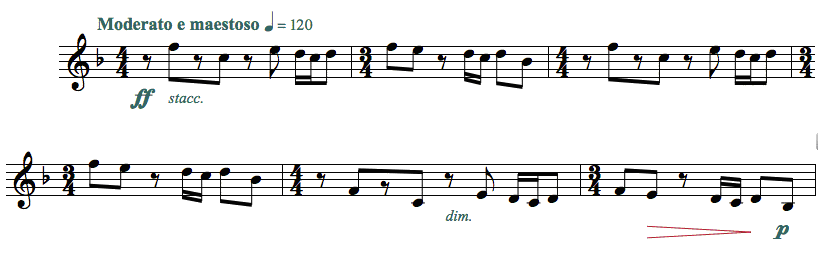
In your vocalization what syllables did you use to indicate appropriate style? Did any syllable or part of a syllable change to imply accent, weight, or arrival? Did your syllables change as the dynamic got softer? Step 2 - Connect Vocalization Choice with Rhythmic Expression Once you have discovered a way to vocalize a passage in a way that demonstrates expressive progress, go back and vocalize the passage again using the same syllable throughout. In the case of our current example, vocalize the passage one more time using only "ta." It should be fairly easy to point out the "clunkiness" of using the same syllable compared to the musical possibilities of multiple syllables. Now discuss how specific syllable, consonant, and vowel choices naturally expose musicality. Be on the lookout for anything that can reflect interpretive choice. Here is how I might vocalize the passage (with my apologies to all fluent in the International Phonetic Alphabet): 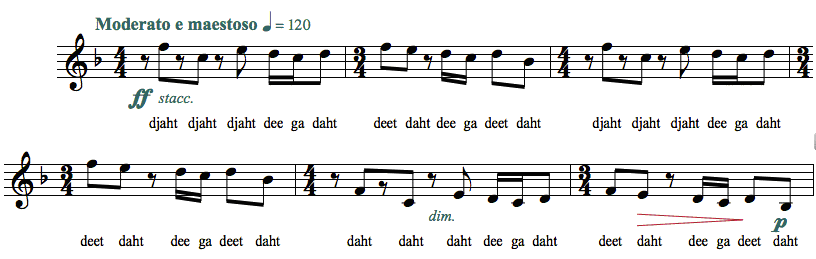
Some possible observations:
Step 3 - Discover Expression in Melodic Line This form of expression might be best introduced using a slower, pretty excerpt. It is up to you how much to emphasize pitch at this point. If passages can be sung in tune, it will only help your cause, however, important musical determinations can be made even if pitch is not perfect. Once again, use something familiar from your rehearsal or from an electronic playlist. For our purposes here, let's use one of my favorites, "Horkstow Grange," the second movement of Percy Grainger's Lincolnshire Posy. Sing this passage several times with a variety of natural syllables. 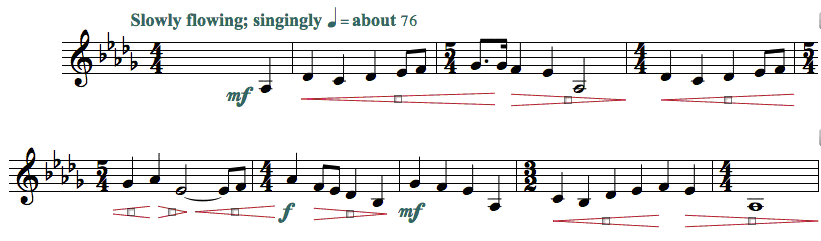
As with the Holst excerpt, discern what possible musical suggestions your syllable choices have. Step 4 - Connect Vocalization Choice with Melodic Expression After your singing has revealed musical expression in a way you find pleasing, go back and sing the passage once more using a single syllable. I might suggest "da" in this instance. The result should be lackluster and unsatisfying. As before, discuss how specific syllable, consonant, and vowel choices naturally expose musicality. I might sing this excerpt as follows: 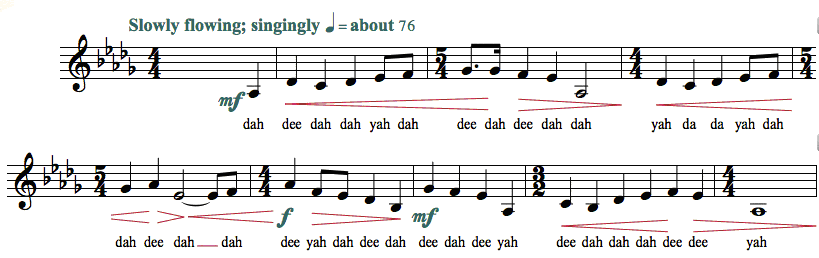
Some possible observations:
Pitfalls and Reminders This is certainly not a foolproof approach, nor is it intended to replace important considerations such as background, historical context, text (if it is a work based on song), audience, occasion, or any other consideration in preparing music for performance. It is hoped, however, that incorporation of natural singing and vocalization will help your performance express more than the notation printed on the page. I would suggest a few reminders and cautions:
Best wishes for more meaningful and expressive performances! Return to top |
|

