

Winter Issue 2014-15
|
Select Issue
Loading
|


 Print this page
Citation View Print this page
Citation View
We'll Be Ready... Whether We Like it, or Not
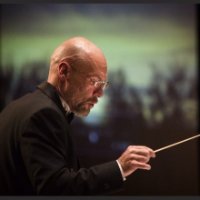
Though the classroom-guitar phenomenon may be well known to you (and I must
admit, having taught class guitar myself, I thought I had a sense of it), the scene I
witnessed this fall at a Powell High School music concert left me pretty stunned.
There, on the stage, surrounded by as beautiful a school auditorium as I had ever
seen, sat two perfect rows of 10-15 headphone-wearing guitar students. And in
the middle of it all, sat a band director (as he had been introduced to me), with
microphone clasped neatly to his head, and a fine-looking guitar in hands. Oh -
and he was singing, right up there in front of everyone, as were his students. The
song? I will never forget it: "You are my sunshine." The crowd of students and
parents in attendance that night weren't stunned at all though. In fact, many of
them were singing, "You are my sunshine," too. Following the concert, I made it a
point to get to know John Fabela. I was fortunate enough to be able to interview
him briefly about both his classroom guitar experiences and his thoughts about
the challenges of teaching high school music today.
Brad: Your high school music program didn't always include guitar instruction.
How, and why, class guitar?
John: The administration approached me about the need to add a course for those students who aren't involved in the visual arts and aren't in band or choir, but need a fine arts credit to graduate. Because I had taught music appreciation in the past and didn't see it as a course my students particularly enjoyed, and because I had a friend who had gone through the G.A.M.A. guitar workshop and enjoyed it, I asked if they'd be willing to send me to the workshop. They agreed. The workshop gives you enough materials for your first year of instruction, and about 30 kids signed up for the class. At first, most of the students thought we were just going to play pop songs. But I said, "No, if we're going to do guitar class, you're going to learn how to read notes and how to read tab. And you're going to learn how to perform in an ensemble." At that point a few kids dropped out, but since then the class has grown to average between 20-30 kids. Over the years I have lost a few students from band. But for the most part, guitar class has been a great addition to the program and has been particularly great for those students who would never have been a part of the music program without it. B: How do you feel about teaching music with guitar and about what you're really accomplishing? J: I think it's a great way to reach those kids who didn't get music instruction in elementary school or who have moved in from a place where it wasn't available. I've had students who really struggle in school but came anyway because they knew they'd get to play guitar first hour. B: Having taught class guitar, I know that maintaining a strong sense of order and curriculum can be a challenge. How do you maintain such a strong sense of purpose in your class? J: I clearly establish my expectations at the beginning of the year, post them on the board, and consistently reinforce them throughout the year. I include everything from the classical playing position I insist they use, to being sure they're familiar with the rubric I use to test them, so they know the specific things I'll be listening for ahead of time. B: One of the clear benefits of guitar study is its potential for lifelong music making. How does class guitar meet your desire to equip students with lifelong music-making skills? J: When students are finished with this class they have the skills to be able to walk into a music store and buy an 'AC-DC' song book or download a Bach sonata. They can read and play the TAB and/or notation and/or basic chord diagrams they find there. Those skills will stay with them for a lifetime. B: That's really incredible, John, but what about traditional large ensembles? How can you justify school guitar instruction at a time when our school bands and choirs need all the support they can get? J: Every time I see a student excel at playing guitar there's a part of me that wishes they'd have chosen band years earlier. But you know, at least they're playing. They're learning about music; they're appreciating music that much more, and they're able to go out there and make informed choices about the music that they're hearing. B: Okay, but as interest in including guitar ensembles, popular music ensembles, and other non-traditional ensembles in schools increases, you can't help but be concerned about the place of traditional concert bands and choirs in America's future schools. In your view, what is the future of school band instruction, and how would you define the 'ideal music teacher' for those days yet to come? J: I think there will always be a place for school bands and choirs. Those kids want to learn how to sing and play music—they want to belong. Bands and choirs are a great way for them to be a part of that, and to work together toward a common goal. I believe that ultimately, music teachers must be passionate about the music they teach. Students need to know that you really care about the music you're teaching, that you really love coming to work every day, that you love seeing their progress every day; and that you enjoy celebrating their successes with them. That's why I became a music teacher, because I had music teachers who were like that. We knew they just loved watching us come into their room. Sure, today's music teachers may also need to know how to play guitar, and how to use technology in their class and more, but the role of the music teacher hasn't really changed. It's still all about building a base of fundamentals, and then showing the kids that they can take those fundamental skills and apply them to the music that they want to play. And yet, a yearlong classroom guitar course does not make one a guitarist, let alone a musician of the caliber that high school bands and choirs graduate into the world every year (whatever their chosen instrument). These are young people who have not only dedicated untold hours toward mastering an instrument, they have learned time and time again that sustained effort over time produces results and that a well-taught group of band and/or choir students working together truly can produce wonders. Still, we must recognize the changes that are coming. Increasing graduation requirements place an even greater emphasis on 'core' subjects, and even greater stress on student schedules. Bands' growing lack of relevance to (and demonstrated lack of perseverance from) the 'instant gratification generation', and reduced arts education funding are all having profound effects on everything from decreasing band enrollments to the addition of 'non-ensemble' and 'non-traditional' music classes (Abril & Gault, 2008; Countryman, 2008; Falconer, 2013: Jolly, 2008; Jones, 2008; Ng, 2011). Circumstances are changing, but according to John 'the role of the music teacher hasn't really changed. It's still all about building a base of fundamentals, and then showing the kids that they can take those fundamental skills and apply them to the music that they want to play.' I couldn't agree more. But trumpets, saxophones, and tubas have been applying fundamental skills to the music they have wanted to play for generations. Are things so very different now? Of course they are—they always are. Whether we like it or not, change is the way of things, and often for the better. The question we must face as music teachers isn't whether or not the world around us is changing; the question we must ultimately face is: Are we? References
Abril, C. R., & Gault, B. M. (2008). The State of Music in Secondary Schools: The
Principal's Perspective. Journal of Research in Music Education, 56(1), 68-81.
Battisti, F. L. (1989). Clarifying priorities for the high school band. Music
Educators Journal, 76(1), 23-25.
Countryman, J. (2008). Missing voices in music education: Music students and
music teachers explore the nature of the high school music experience. (Doctoral
dissertation, University of Toronto). Retrieved from ProQuest Dissertations
and Theses. (NR39801)
Falconer, L. (2013). A comparison of the perceptions of music educators and
school administrators regarding trends in secondary curricular offerings and
implications on student body participation. (Doctoral dissertation, Boise State
University).
Fraser, H. (2013). Motivations and instructional preferences of high school guitar
students: A mixed methods study. (Doctoral dissertation, University of Delaware).
Jolly, D. R. (2008). Music educator perceptions of declining enrollments in Texas
band programs. (Doctoral dissertation, Stephen F. Austin State University).
Jones, P. M. (2008). Preparing music teachers for change: Broadening instrument
class offerings to foster lifewide and lifelong musicing. Visions of Research in
Music Education, 12(1).
Ng, C. H. C., & Hartwig, K. (2011). Teachers' perceptions of declining participation
in school music. Research Studies in Music Education, 33(2), 123-142.
Seifried, S. (2006). Exploring the outcomes of rock and popular music instruction
in high school guitar class: A case study. International Journal of Music
Education, 24(2), 168-177.
Return to top |
|