

Convention Issue 2013-14
|
Select Issue
Loading
|


 Print this page
Citation View Print this page
Citation View
Young Composers: Getting Your Music to the Performers in One Piece

Congratulations! You have just completed your first
major composition and engaged a local ensemble to
read it for you. As they are donating rehearsal time, it
is important that your work be clearly read, accurately
interpreted and correctly performed by the conductor
and the ensemble. A little preparation can make this
an easy task.
Before you complete the final version of your work, consider the following:
Tempi Always indicate a tempo—always. A metronome marking is the most accurate way:  = 144 = 144
A style and a metronome marking are even better: = 144
If in doubt, use circa as an approximation: = ca. 144
Rehearsal numbers In instrumental works, always include rehearsal numbers—always. Place them a minimum of every eight measures in 4/4 or 3/4 (I have yet to hear anyone complain about having too many.). Use numbers, not letters (unless it is a marching band arrangement). They should reflect the measure numbers at points of musical events (entrances, textural shifts, dynamic changes) and be framed with a square or circle so as to catch the eye. On the score, they should be large enough for easy reading by the conductor (14 point font—the default size in Finale software, should be the minimum). Notes Make sure stem directions are correct. Unless it is absolutely necessary, avoid mixing sharps and flats in the same line or phrase. 
When notating accidentals, remember that you are writing a composition, not a theory exercise. Use the spelling that will be most familiar to the player. Anyone playing a B-flat instrument such as a clarinet or trumpet will read G-Ab-Bb much more quickly and efficiently than G-G#-A#. Use courtesy accidentals. No, really—do it. It will save time. 
Rhythm Beam notes according to the metrical pulse and/or grouping. 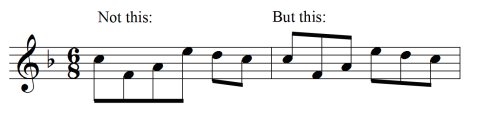
Be sure the beat is visibly clear. 
The more complex rhythms become, the more important this is. 
Notate the common note value in meter change when the unit of beat differs. 
Note also that in the example above, the grouping of the asymmetrical meter is clearly indicated through numbers and beaming. Dynamics Place dynamic marks under the note they affect. If the part has an extended rest and returns at the same dynamic level, repeat the dynamic as a reminder. Transitional dynamics (crescendos and diminuendos) should include an arrival dynamic. 
Articulations Be familiar with the ways in which different mediums interpret articulations: an accent in choral music implies weight; in instrumental music it means an emphasis (often forceful). A curved line for winds means to play smoothly with no audible tongue. A curved line for strings means take all the notes in one bow. A great deal of contemporary instrumental music is heavily marked in terms of articulation. Resist the urge to put a sign over every note, but instead use a general marking when it will suffice (leggerio, marcato, legato). Scoring Considerations In a capella choral music, be sure to include a piano reduction of the choral parts in case the pianist has difficulty with open-score reading. In larger ensemble works, cue or double those instruments which are likely to be fewer in number or missing entirely (double reeds, horns). This gives the conductor options. Cues for entrances are also helpful, particularly if there are long periods of rest (as in many percussion parts). Give adequate time for brass mute changes. When scoring for percussion, be sure to notate the required instruments on the top of each individual part and on the conductor's score. If more than one player per part is required, be sure to note how many players are called for. No, really—do this. It will save a great deal of time. In scoring for timpani, notate the pitches at the beginning of the piece. Make sure any tuning changes are clearly indicated and that the player has adequate time to facilitate them. English and Non-Musical text Use one language consistently. 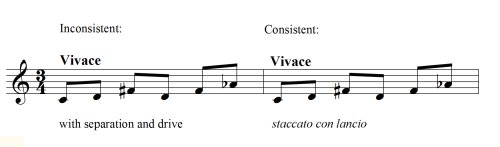
Use Program notes to convey non-musical ideas such as a story or inspiration for the piece. Use Conductor notes to convey technical information that is not possible or practical to include in the score—e.g. "if a wind gong is unavailable, use a small crash cymbal." Do not waste words stating the obvious—e.g. "Dynamics are very important" or "Be sure to stress accents." Check for correct spellings. This includes choral text, terms and instruments names.
Formatting Parts Instrumental parts should be spaced with about four to six measures per line for easy reading. Paper is much cheaper than rehearsal time. Eliminate awkward page turns. Not every performer will be equidistant from their part. Choral performers will be much closer to the page than a bassist or timpani player, so be sure the size is legible. One final thought Hearing one's music performed live for the first time can be an enlightening and educational experience. With the proper forethought and careful preparation, it can also be a thrilling one for you, the conductor and the performers. Happy listening! Return to top |
|