

Fall Issue 2011-12
|
Select Issue
Loading
|


 Print this page
Citation View Print this page
Citation View
Kansas Music Innovators: Striving for 100%
There has been much discussion about the need to reach out to students who do not participate in "traditional" music programs, especially at the high school level. Referring to students who are not in band, choir, orchestra, or jazz ensembles as the "other 80%," Dammers (2011) states, "The fact that most students do not study music beyond mandated general music classes should bother us, as it conflicts with the idealistic belief that If music is important, it is important for everyone."
In general, music educators agree that making the school music curriculum more diverse and inclusive (e.g., guitar classes, composing labs, steel drum bands) increases the potential to attract students who are not in the traditional music ensembles. What seems to be less acknowledged is that students in those typical instrumental and vocal groups can also benefit from such musical opportunities as well. At the recent NAfME (formerly MENC) National Assembly I attended in June, discussions by delegates from across the country identified a variety of issues regarding the gap between what is traditionally included in most school music programs, and more innovative musical offerings. Some of those issues included:
Coordinator of Fine Arts & Physical Education Kansas City, Kansas Public Schools
Instrumental Music - Haven High School Haven, Kansas
Brad Shores and his steel drum band perform.
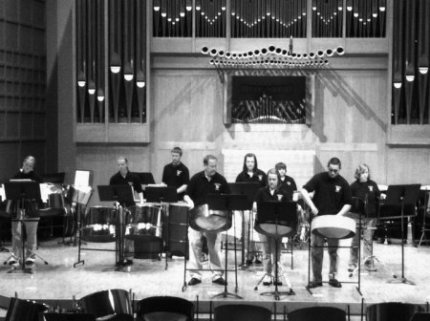
Brad Shores and his steel drum band perform at the 2011 KMEA In-Service Workshop in the two videos below.
1. Why did you start it? I started the steel drum band because it has been an important part of my life and I wanted to share it with students. The steel drum is such a unique instrument that people of all ages seem to enjoy it and the sound is pleasing to all who hear it. Steel drums have allowed me to reach out to a group of students that I may not have ever had the vehicle to teach. I have also had the opportunity to explore composing and arranging music for steel drum bands. 2. How did you get support for it? In both districts that I have had a steel drum band, the administration has been extremely supportive. I only had to mention that I would like to have a steel drum class and the administration allowed me to put the program in the curriculum. While there is no defined budget, I am allowed to use funds from the general band fund to buy mallets and music. I have been granted use of school owned vehicles to transport drums and students to contests, public performances, and festivals. Needless to say, students and parents have really been the backbone of the steel drum band because they help with equipment needs, transportation, sponsorship, and countless other issues. 3. How long have you had it? At Nickerson High School, where I taught from 1989 to 2000, I started the steel drum band in 1995 after purchasing 4 steel drums for the band. By the time I started teaching in Haven in 2000, I had purchased drums for up to 14 players. I began buying drums from Trinidad and over time, I was able to buy a variety of drums; including leads, double seconds, cellos, and basses. The total amount I have personally invested in the steel drum program exceeds $12,000 of my own money. 4. How is it structured? The steel drum band class meets every day during third hour and is open to any student in the school. Some of the students are members of the regular band program which includes marching, jazz, pep, and concert bands, as well as a novelty percussion group called the "Trash Cats." Other students, who have never been in any instrumental music group at all, have joined to be a part of this very special group. There is no prerequisite for membership; however, prospective members must get the approval of the instructor to join the class. 5. What types of activities has this group done? The steel drum band is a very active group and has performed at KMEA four times in the last ten years. In addition, the group regularly performs at music festivals in and out of state, football and basketball games, local band concerts, steel drum festivals in Wichita, and countless other special functions. 6. Any other comments? Because of the immense support we receive from parents and administrators, the Haven steel drum band has been a pilot program for other schools in Kansas who have started their own groups. Choral Music - Shawnee Heights High School Topeka, Kansas 1. Why did you start them? I wanted to capture the students not in band, choir, and orchestra. I knew there were many students who were not participating in the music program, and that did not seem right. The goal was to provide opportunities to attract those students for whom ensemble music was not a priority for music making. 2. How did you get support for them? I proposed these options to the administration because there were no music classes for students not in the music ensembles. It seemed obvious that there was a need to expand what was offered in the music program. They were very receptive. Parents are also very supportive and have asked if they can take these classes! 3. How long have you been teaching these classes? This fall it will be seven years. Both have become very popular with students through the years. 4. How are they structured? There are three guitar classes that typically enroll about 75 students per year. There are three composing classes per year of about 30 students each. In that class, the students compose on Apple computers. There are a few students who are in both classes, but most are not. 5. What types of activities have they done? For the guitar class I have not pushed the idea of doing concerts. The students are not so much into ensemble playing, but more interested in personal music making. I think it puts a lot of pressure on them to think about playing in front of others. I do not present this as a performance class. I approach the guitar and composing classes as extensions of, and building on, what the students did in their elementary general music classes. You can go to http://www.usd450.net/webpages/rdoole/news.cfm?subpage=797528 and hear some of the student compositions. 6. Any other comments? I thought it was worth the effort to explore options for students who were not in band, choir, and orchestra. There has been as much interest in these classes as the choral program, not in a competitive way, but from different groups of students. I really believe more students are a part of the overall music program as a result.
Return to top |
|