

Fall Issue 2011-12
|
Select Issue
Loading
|


 Print this page
Citation View Print this page
Citation View
Introducing the Art of Composing to High School Students
I believe that everyone is a composer, but some may disagree with this statement. Even trained professional musicians and educators may be hesitant to call themselves composers of music. However, many of us hear melodies in our minds that are at least partially of our own making. How many of us have sat at a piano or picked up an instrument and started to play random notes without using written music? It is likely that many people, especially musicians, have experienced both of these activities, at numerous times in their lives.
As music teachers, we encourage students to practice and perform at concerts, contests, and other public events; but how many teachers encourage students to write music? Is composing reserved only for a select group of highly gifted musicians? Creston (1971), a twentieth-century music theorist and composer, said it is not. He stated in his composer's creed that it has always been my belief that musical composition is not for the chosen few but for every normal person . . . .It should be as much a part of academic studies as literary composition-not necessarily to make professional composers of everyone, as we do not intend to make authors of every student of literature, but for the joy of individual creation (91-93). Extensive research has been done to explore the benefits of incorporating composition into the music curriculum, and student outcomes have been studied (Webster 2002, Wiggins 2002, Hickey 2003). Some believe that the act of composing is one of the best ways to foster a student's creativity and critical thinking skills. Hickey and Webster (2001) described some common characteristics of a creative person as risk taking, having a sense of humor, attraction to ambiguity, open-mindedness, a capacity for fantasy, and perceptiveness. This description relates directly to the process of how one composes. However, in secondary schools, especially high schools, very little has been done to increase compositional activities. One of the possible obstacles explaining a lack of student composing may be that an overwhelming number of high school music programs are dominated by performance courses, such as band, orchestra, and choir, instead of the general music focuses that take place in elementary music classrooms (Randles 2006, Schopp 2006). Randles (2006) believed there is a lack of opportunities or environments in which to compose music in the high school ensemble or for the high school ensemble's classroom. He stated, "General education embraces cooperative learning and student empowerment, while the high school band community is in many respects continuing as has been the tradition, with regimentation of musical learning centered on the director" (p. 3). In a recent survey of New York band directors, Schopp (2006) found that composition did not appear as a frequent component in the ensemble classroom due to lack of time within ensemble classes because of rehearsal and performance commitments. KMEA offers a composition contest for Kansas students. As a music teacher, I wanted to explore how we could introduce the art of composition to high school students. I started with several questions. Could high school instrumental and vocal students, who may not have a music theory background, compose a musical composition? If so, what is the process and approach that enables students to compose? How do the participants discover the processes to compose? How much previous knowledge is available as an instrumentalist? How much information is required from a teacher? To find possible answers to these questions, the following project was conducted as part of the Horizon Grant Projects in Musical Composition with the Salina Symphony. Seven students, who volunteered from the Salina Youth Symphony Program, participated in weekly workshops in musical composition. The following guidelines/goals were used in the workshop:
COMPOSITION WORKSHOPS Week One-Ostinato Rhythmic Composition During the initial meeting, I familiarized students with the process of creating a musical composition, which I defined to them as a "Series of Organized Sounds." I led students in "Ostinato Composition" using small hand-held percussion instruments, a process that I learned in the Creative Strategy Class at Teachers College. Each student was asked to compose one measure of rhythmic pattern with a given tempo and time signature. One leader conducted the group of students controlling the entrances and dynamics of the ensemble. We recorded each group using a wave recorder. The process was easy to teach, because students discovered how simple it is to create a composition and then became excited to take the next step. At the end of the workshop, I instructed students how to notate using "Finale Notebook." Following is the assignment.
Assignment:
Week Two - A Solo Composition for Your Instrument
The second workshop began with performances of the solo compositions, followed by discussions and questions. Since the students composed for their own instruments, which they knew well, they were able to compose a complete melody using the notation software without much difficulty. It seemed to me that the experience of performing with concert band and orchestra had helped them to create balanced and well structured melodies. 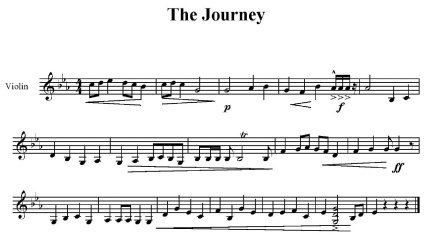 A melody composed by a student
Assignment:
Week Three - Compose an Accompaniment Part to the Solo
The third workshop began with a recital of each composition using an accompanist. It was impressive and rewarding to observe that, in three weeks, each student was able to compose a solo, complete with a piano part. The compositions were simple, not complicated in structure and harmony, but successful as a complete composition that followed the guidelines. The next step was to instruct the students to start a draft for the final ensemble composition. To organize thoughts and processes for the final project, the Composers' Workshop (Ruthmann 2007) process, and based on a writer's workshop approach by Easton, Witek and Cione (2005), was presented to the students. Composers' Workshop Process The students followed several steps (below) according to Diagram 1. 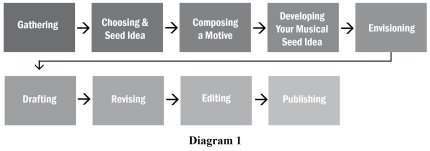
Choosing & Seed Idea: An inspiration for the composition is chosen. Composing a Motive: A small musical motive should be composed to match with the seed idea. Developing Your Musical Seed Idea: This is the development of motive through musical transformation. Envisioning: This is the application of form and structure. Drafting: This is the process of putting ideas on paper or in an electronic file. Revising: This is a process of reflection and evolution. Editing: This is the time to rehearse. Publishing: This is the performance of the work and the creation of a final score.
Assignment:
Weeks Four to Six - Compose a Draft of the Ensemble Composition
In the next three weeks, no formal workshop sessions were scheduled, but students worked with me in loosely-scheduled individual sessions and active communication through e-mail. All students chose to start a new composition. It was interesting to notice that three of the students, with piano backgrounds, chose to incorporate piano in their compositions, and the other four students chose to compose using three or four single-line instruments. Week Seven - Revising and Publishing the Composition After three weeks of individual work, students gathered to present their drafts at the workshop. Computer playback was used for the presentation rather than live performance. During the sessions, we displayed the drafts of each student's composition using a projector to discuss the improvements to be made in notation and appearance. As the final step, we discussed the publication of the compositions. I emphasized that the compositions must include all necessary information (e.g., dynamics, tempo markings, etc.) to show the composers' intentions to the performers. Also, I informed them that the compositions must be organized clearly so the performers could rehearse and perform without difficulty in reading the composition.
Assignment:
Week Eight - Lesson with an Expert and Preparation for the Performance
As part of the composition project, Timothy Mahr, from St. Olaf College, was invited to Salina to work with the students. In 30-minute individual sessions, each student shared his or her composition with the composer and he provided suggestions and comments. The sessions provided students with new perspectives and insights into their work, allowing them to modify their compositions. Concert of the Final Composition The final composition concert was held in Sams Chapel at Kansas Wesleyan University. At the concert, I purposely did not allow student composers to perform their own compositions so they could listen and experience the births of their pieces. The students completed well-crafted compositions for their small ensembles, and the concert was successful. I was impressed with both the creativity and the sensitivity that the students demonstrated in their individual compositions. Timothy Mahr made the following remarks at the concert: "These students have showed some amazing craftsmanship and created amazing works as beginning young composers." 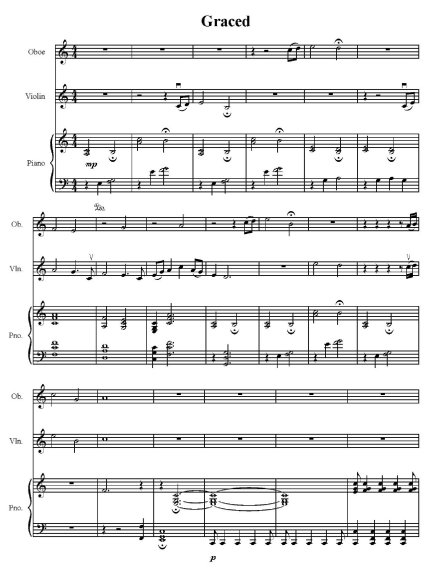 A sample page of student composition
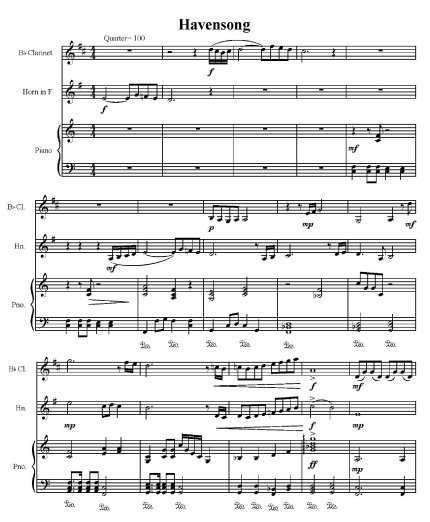 Havensong (2:59) Student composition audio sample 2 (2:49) Conclusion Each student had a natural instinct for composition. It appeared that, from their music classes and other musical experiences, they all knew about good melody, harmony, orchestration, and phrasings. Having a set of clear guidelines and goals for each session helped to meet an ultimate goal of composing for the final composition. Additionally, it was important to have a place or environment, such as the mini performances at the beginning of workshops and the final composition recital, where the students could hear and discuss their music. The main struggle encountered during the project was the realization of the sound into the musical notation. The students had many great ideas, but struggled to notate them so that they could be reproduced later. We discovered that the use of the musical notation software was critical for students to complete their final projects. The software provided instant audible feedback of their work, and also gave visual guidance as students progressed. It also provided a tool to transpose instruments when necessary. I found that, throughout the process, many questions from the students were simply about how to use the notation software. The project was a positive experience for everyone involved. Given the right tools and guidance, our students can compose well-crafted, notated compositions even without an in-depth study of music theory.
Return to top |
|